
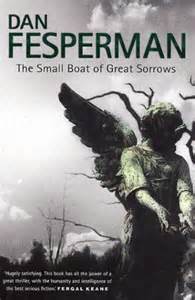
My version: Hardback
Genre: Historical Fiction
Publisher: Transworld
First published: 2003
ISBN: 0-593-05039-8
Pages: 346
Bought
From the cover:
Vlado Petric, former detective in war-torn Sarajevo, has left his beloved homeland to join his wife and daughter in Germany, where he scratches a meagre living among the dust of former conflicts on the building sites of the new Berlin.
Returning home one evening, he finds an enigmatic American investigator waiting for him in the small apartment he now shares with his wife and daughter. The investigator, Calvin Pine, works for the international War Crimes Tribuneral, and he tells Petric that they want him to go to The Hague. It doesn’t take Petric long to accept, especially when Pine tells him they are after a big fish; one of the men who they think is responsible for the terrible massacre of Sebrenicia.
What Petric doesn’t know is that he is also being used as bait to lure into the open a murderer from the perevious generation; a man whose activities in the Second World War make the current generation of killers look like amateurs.
As Petric travels from modern-day Germany, through the ruins of Bosnia, to the peaceful hills of southern Italy where bitter, unresolved tensions still crackle beneath the surface, the stakes become all too personal. And he soon finds that investigating the mysteries of the past can be every bit as dangerous as finding his way through the war zones of the present.
This was a really excellent book, that might start off slowly and studied and have you wondering where all this is going, but really gets underway in the second two-thirds and makes up for all the ‘what’s this all about then?’ of the first part. It then delivers an exciting, thought-provoking final climax.
Anyway…
It is about one Vlado Petric, a Bosnian ex-Policeman, who escaped from the troubles and is now working on a building site in Berlin. He is found, tracked down and recruited by some Americans who work for the War Crimes Commission in The Hague. They want to send him back into the former Yugoslavia to track down a suspected war criminal called Pero Matek, who has gone to ground and integrated himself in the Bosnian business and, of course, the black market community. In between times, Vlado is contacted by an old soldier called Haris (who may even have been Petric’s wife’s lover, while she was still in Bosnia, waiting to join him in Berlin). Haris has information about one of the war criminals who has also found his way to Berlin. Things get a little out of hand, Haris and a friend kill Popov and call on Vlado to help dispose of the body. Then, wouldn’t you just know it, but Popov is high up on the War Crimes list and they are doing all they can to track him down. They suspect he is in Berlin, but can’t seem to find him. Petric is taken to The Hague, briefed and then sent into Sarajevo, where he tries to make contact with Matek. Matek escapes, but a relative of Vlado’s turns up some photographs which blow up all Vlado thought he knew about his and his father’s past, in his face.
The book finally hinges on Matek’s relationship with Vlado’s dead father and how this colours Vlado’s pursuit of him. The more Vlado finds out about Matek, the more he learns about about his father and his own past
Don’t worry, when you’re reading the book, it is much easier to understand the twists and turns than I’ve made it above.
I must admit to having some doubts in the start, that it wasn’t as immediately captivating as I remember Dan Fesperman’s The Arms Maker of Berlin as being. But give it time and you’ll be hooked and if you’re anything like me, you’ll be glued to it. The story builds slowly, picks up the pace in a very satisfying manner, revealing its secrets (and sorrows), moving from the Balkans to Italy via the Second World War and the mayhem of revenge that was the break-up of the old Yugoslavia. Looking back, I can see how well paced it actually was, making the most of a pretty melancholy and reflective storyline and showing the near impossibility of either fully understanding or solving the situation in the Balkans as it was or is now. I thought underway, that you would have to go back to the time when the first caveman from one side of the mountains, hit the first caveman from the other side of the mountains, to be able to point to who started ‘all this’ and get away from the endless “we’re gonna do this to you in revenge for what you did to us” “well, we’re gonna do this to you in revenge for you doing that to us…” and so on. No-one’s is able to say; “Stop! Forget all that’s happened before, let’s start again.” They’d be shot. And would need revenging. If that’s a word.
A thoroughly enjoyable, rewarding read. The only thing keeping it from a 5th star, is – being a novel/thriller by an American author, there of course has to be (at least) one occasion where someone ‘punches’ a number in to a mobile (or just about any other type of) phone. There must be some sort of law. The 20th Amendment to the Consti-bloody-tution or something. You go check. See if I’m not right.
You can buy The Small Boat Of Great Sorrows by Dan Fesperman from Amazon
Photo by Nancy Hann on Unsplash

 Couldn't I Just Tell You