

My version: Paperback
Genre: Historical Fiction, Britannia, Saxons, Jutes, Angles
Publisher: Flying Squid
First published: 2019
ISBN: 9781670093349
Pages: 59
Supplied
From the cover:
“Thirty years have passed since Britannia voted to throw off the Roman yoke. Now, the old world crumbles.
Ash is a Seaborn, a Saxon child found with nothing but a precious stone at his neck and a memory of a distant war from which his people have fled.
Raised on the estate of a Briton nobleman, trained in warfare and ancient knowledge, he soon becomes embroiled in the machinations and intrigues at the court of Wortigern, the Dux of Londinium, a struggle that is about to determine the future of all Britannia.
A child of Saxon blood, an heir to Roman family, his is a destiny like no other: to join the two races and forge a new world from the ruins of the old.”
A thoroughly entertaining and not least illuminating look at immediate post-Roman Britain. The Romanisation influence is beginning to fade, though some Britons, and other imported peoples, are trying to cling on to (Roman) life and the Pax Romana as they knew it. And life as they knew it is about to undergo an almost cataclysmic, not to say violent, series of changes, as the peoples from northern Germania and up into the Jutland peninsula cross the North Sea in search of new lands, new homes, and new riches.
The Song of Ash, is a riveting tale of honour, betrayal, and redemption, readers are taken back to a richly imagined fifth century Britainnia and a world seething with political intrigue, vivid battle scenes, and vividly developed characters.
In the 5th century, Great Britain was undergoing what would turn out to be quite significant transformations. The withdrawal of Roman forces in around 410 AD left quite the power vacuum, and the old Britannia, the new Britain, was subsequently invaded by various Germanic tribes. The Angles, Saxons, and Jutes established kingdoms across the land, ushering in the period known as the Anglo-Saxon Heptarchy. How many of these peoples were already here, I think is still open to debate. As I remember, Francis Prior isn’t a big fan of the invasion idea, as in, there wasn’t one day (like 1066) for a Saxon (etc) invasion and conquest, but it was much more gradual. Possibly as those peoples already in Britannia, invited their co-tribes over. Obviously, there were large areas that wanted to somehow keep the old Roman status quo, and fought against the slow assimilation that ‘threatened’ them. The old peoples of the land, already marginalised during the Roman period, were marginalised some more by the new wave of northern European tribes coming over, and were even called a word which derives partly from their word for ‘strangers’, Welsh: Strangers in their own lands.
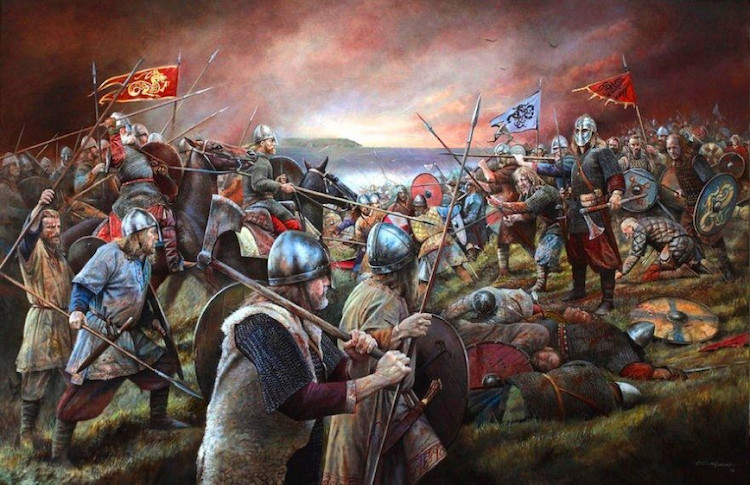
In any effect, into this already tumultuous melting pot, these new Germanic rulers brought with them their own languages, cultures, and societal structures, gradually reducing even erasing, the Roman influence that had held sway for over 350 years. 5th century Britannia in general, can be characterised by the establishment of these Anglo-Saxon kingdoms and the gradual blending of native British and Germanic cultures.
James Calbraith skillfully constructs a truly captivating world of intrigue and restless conflict amongst these complex clashing worlds. The intricate political landscape, where warring factions vie for power, adds multiple layers of depth to the story. The author’s attention to detail in crafting the history, culture, and customs of Saxonia is commendable. From bustling city markets to treacherous battlefields, the vivid descriptions bring the world to life, immersing readers in its every facet. The story is told in a flowing, easy to digest style, with many finely drawn characters to evoke sympathy or disdain, well-worked set pieces, and hey!, lot’s of interesting and subtle history lessons under way.
There are some really memorable characterers, quite apart from the ‘main’ protagonoists of Ash and Eadgith. Fastidius and the people at the old Roman villa, early all of the Iutes (presumably Jutes (from Jylland, where I live now), waiting for the J to be invented (there was no letter ‘J’ in any language prior to the 14th century in England – Ed)). All distinct and multi-dimensional, making it easy to invest emotionally in their experiences. The main protagonist is of course Ash, who develops convincingly from an innocent, Saxon refugee, almost unknowing of his troubled past, growing up in and around an old Roman villa, to an honourable potential warrior, is particularly captivating. Calbraith skillfully explores his and the others’ internal and external struggle as they adapt to growing older in a truly tumultuous time, allowing readers to empathise fully with their triumphs and defeats.
Calbraith’s ability to keep readers on the edge of their seats is commendable. The intricate plot unfolds gradually, revealing hidden alliances, shocking betrayals, and unexpected alliances on just about every page. The book’s pacing is spot-on, effortlessly alternating between intense action sequences and introspective moments, creating a captivating rhythm that keeps readers engaged throughout.
While the book delves into themes of power and honour, it also explores the human capacity for redemption and resilience and Calbraith expertly weaves together elements of tragedy and hope, allowing the characters to grow and evolve organically. The emotional depth of their journeys is moving, leaving a lasting impact on readers long after the final page is turned.
“The Saxon Spears – The Song Of Ash” is a energising adventure that transports readers to a world filled with intrigue, unforgettable characters, and hold-your-breath battles. With exceptional storytelling skills, vivid world-building, and a compelling plot, Calbraith makes this book an absolute must-read for fans of the period and the genre. And is just the start of what looks an inspirational series.

 Couldn't I Just Tell You