
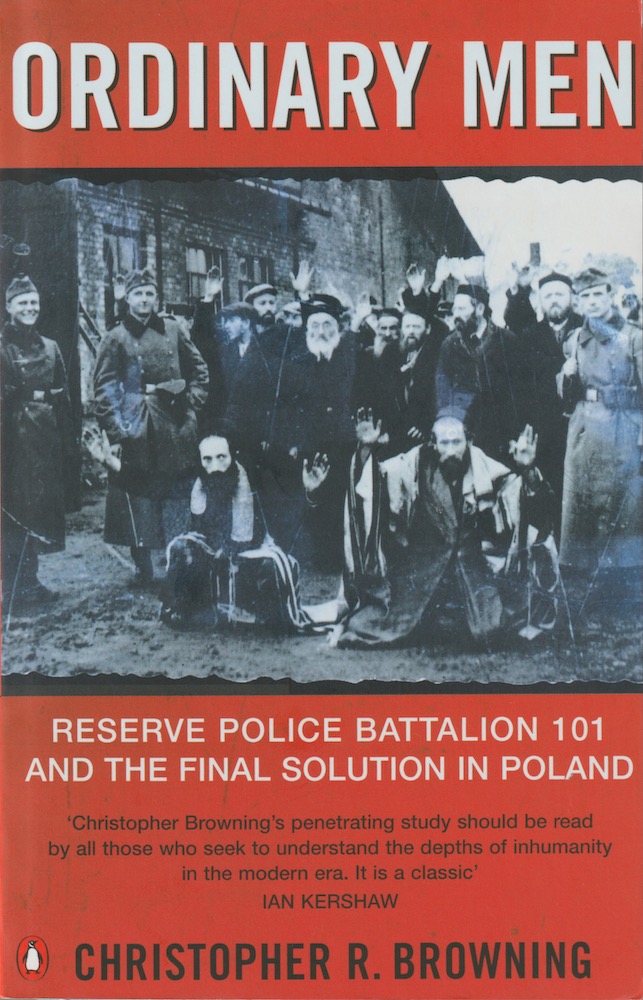
Reserve Police Batallion 101
and the Final Solution in Poland
My version: Paperback
Genre: Non-Fiction, WWII, the Final Solution, Germany, Poland, Russia
Publisher: Harper Collins, Penguin Books
First published: 1992
ISBN: 978-0-14-100042-8
Pages: 223
Bought
From the cover:
“In 1942 a unit of ordinary, middle-aged, German reserve policemen were ordered to liquidate a Jewish village. Most of them had never fired a shot at a human being before, yet they killed with little hesitation and eventually went on to slaughter tens of thousands in cold blood. How could this transformation have taken place?
Christopher R. Browning’s shocking study of how Reserve Police Battalion 101 became mass murderers has already achieved classic status all over the world. By examining the policemen’s frank personal testimonies from their post-war interrogations, he builds up a startling study of human evil in the Holocaust. He does not present us with psychotic sadists, and, in his powerful response to Daniel Goldhagen’s ‘Hitler’s Willing Executioners,’ also refutes the idea of a persuasive anti-Semitism unique to German culture. Instead, the result is a far more disturbing view of humanity – one which also has powerful implications for society today.“

There can be no simple answer. No one reason that can be pointed at with, “so that’s why.” I guess that should be recognised by most serious readers as going without saying.
Another thing to point out, as Christopher R. Browning also does in the opening paragraphs; these “frank personal testimonies from their post-war interrogations,” aren’t exactly that. They’re mostly from the time in the 1960s, when the surviving members of 101, were being tried for their war crimes. It wasn’t really in their interests to give a full and frank description of what they did, where and how. It’s not quite a case of “I personally didn’t shoot anyone of course, actually, some of my best friends are Jewish. I was there yes, and I saw Heinrich (now conveniently dead) shoot a lot,” but in the same ball-park. They don’t use the “I was only following orders” line either, seems that only those higher up got to use that one.
What Browning has had to do, is use their testimony and check and double check and work out what must have happened from what we know did actually happen.
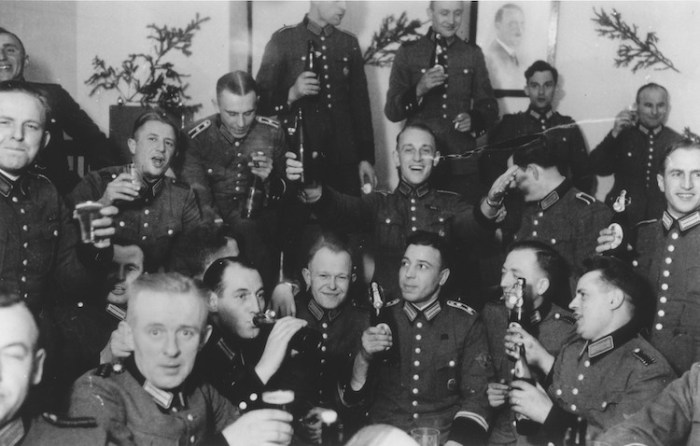
Browning argues that these men were not sadistic or fanatical Nazis, but rather ordinary, middle-aged, working-class men who were gradually led to commit atrocities by a combination of factors, including peer pressure, obedience to authority, and the dehumanisation of their victims.
Daniel Goldhagen, on the other hand, in Hitler’s Willing Executioners, argues that the men of Reserve Police Battalion 101 were not reluctant killers, but instead willingly murdered Polish Jews in the cruelest and sadistic manner possible. He argues that these men were motivated by a deep-seated antisemitism that was widespread in German society. He also argues that the Holocaust was not the product of a few evil individuals, but rather the result of a culture of antisemitism that had been developing in Germany for centuries.

I don’t know enough (yet) about German society and culture of the period and down the ages, so I can’t really comment fully on his beef with Daniel Goldhagen. Though what he says does seem to make a lot of sense. I think though how Browning sees himself differing with Goldhagen over is that the anti-Semiticism in German society angle was just one angle of many at work causing the actions of Police Battalion 101. I get the idea that Browning is really saying Goldhagen puts it all down to this anti-semitism, with very, very little scope for allowing any other reasons to creep in. None that could measure up to Goldhagen would deem strong enough reasons to turn seemingly ordinary German men into mass murderers.

Interestingly, since reading this book (again), I’ve found references to the situations dealt with here, mentioned in other books. For example, in The Constant Soldier, by William Ryan, he has a wounded German soldier who has returned to his village due to awful injuries sustained on the Eastern Front, say to his father one evening:
“He’s not exceptional – you must see how brutalised people have become. We have forgotten what’s right and what’s wrong. In the army you don’t think for yourself – you are directed by your superiors and the will and the cohesion of the group in which you fight. Personal feelings of morality, right and wrong, pity, compassion – they all fall away. When everyone is doing something, you end up doing it too – without thinking about it…”
As a couple of paragraphs later, Ryan has the character (‘Brandt’) say he was just an “an ordinary private,” if William Ryan wasn’t thinking of this book, then I’m a monkey’s father’s brother. UPDATE: After recently finishing The Constant Soldier, I looked at the bibliography, and Ordinary Sodiers is in there, so one point to me!
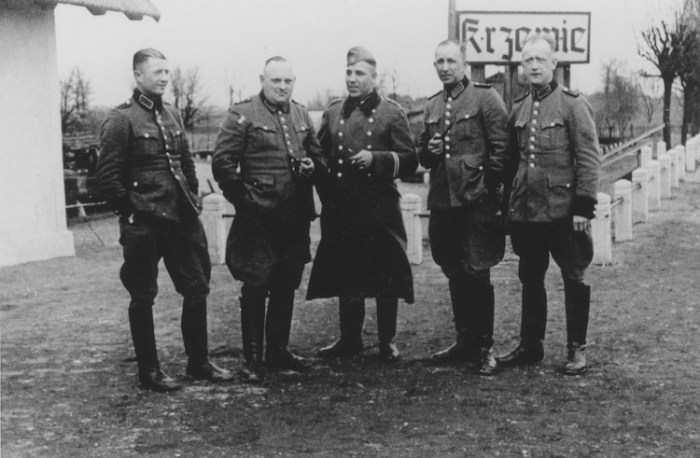
I won’t go into what Browning puts forward as reasons; that’s what the meat of the book is about. My own thoughts on this subject have been for a while, something that he doesn’t seem to think worth writing about, but I wonder: It was all done a long way from ‘home.’ Kind of like a “what happens in Vegas…” angle to it? It was done in the far east of Poland and in Russia following the German front line advance – sometimes seemingly the very next day. If they did it in a foreign land a long way from home, was it real? Did they really do it? Maybe shows why they could go back to Germany, many of them, and pick up more or less where they left off. David Cesarani in ‘Final Solution,’ while talking about US newspapers like New York Times who were isolationist, but based most of their reporting by using AP and UP’s correspondents in Berlin’s reports on Nazi atrocities in the east, “Ultimately, the content came from a far-away place and frequently seemed quite unbelievable.” That’s the thinking I’m wondering if there wasn’t amongst these ‘ordinary men.’
I dunno. I’d like one day to have the opportunity to speak to Mr Browning on this…and obviously find out that he threw away the piece of paper with musings in that direction on it, the morning of day one of the writing of this book.
Ordinary Men is a powerful and important book that is essential reading for anyone who wants to understand the Holocaust and the nature of human evil. It is a difficult book to read, but it is also a necessary one. His thoughts are sound, and his research is obviously impeccable. The book is very readable, I’ve read it twice now, and will reward further readings. I’ve got the Hitler’s Willing Executioners book as well, and I look forward to building my own impressions of the two angles in the near future.
You can buy Ordinary Men from Amazon

 Couldn't I Just Tell You