
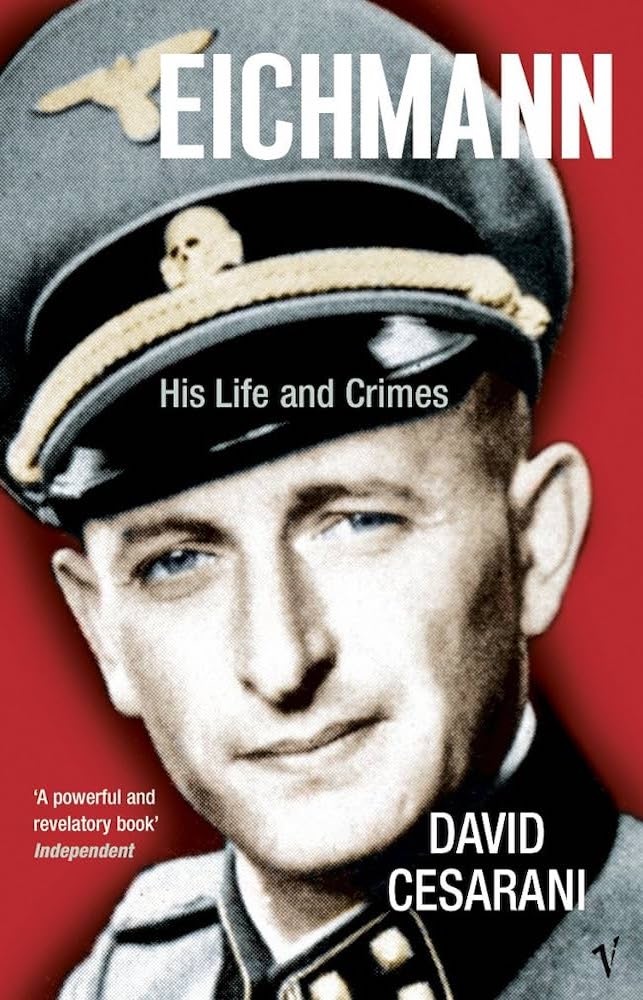
My version: Paperback
Genre: Non Fiction
Publisher: Vintage
First published: 2005
ISBN: 978-0-099-44844-0
Pages: 368 (plus, glossary and abbreviations, notes, sources and bibliography, acknowledgements, index)
Bought
From the cover:
Adolf Eichmann was responsible for transporting over two million Jews to their deaths in Auschwitz-Birkenau and other death camps. Yet he was an obscure figure until his sensational capture by the Israeli Secret Service in Argentina.
This is the first account of Eichmann’s life to apprear since his trial. It is a groundbreaking biography of one of the most fascinating of the Nazi leaders. Drawing on recently unearthed documents, David Ceserani shows how Eichmann became the Nazi Security Service’s ‘expert’ on Jewish matters. He argues controversially that Eichmann was not necessarily predisposed to mass murder and explores the remarkable, largely unknown period in his career when he learned how to become a prepetrator of genocide.
My thoughts. To (most of)us now, he seems like he should be a monster. Killing, or rather delivering to be killed, millions of people. And at the time, of the post-war trials, he was also a shocking figure. But that is comparing him to the society that won, and came to dominate (at least) Western thinking after WWII. We aren’t comparing like for like, when we think ‘how could he have done it?!’ We need, as ever, to set ourselves into the environment he grew up in and was then influenced by, and STILL say ‘that is shocking.’ We would have thought differently perhaps, if we were based in London during the Nazi period. But would we have been able to have done differently if we had grown up, and worked, alongside Eichmann? Of course, one would like to think so.
Eichmann is a monumental biography of Adolf Eichmann, often called ‘the architect’ of the Holocaust. It wasn’t he who thought of it, who commissioned it, nor was in charge often of carrying it out, but it was he who got it to function and he who later pushed it forward in the face of all obstacles. David Cesarani draws on a wide range of sources, including newly unearthed documents, to provide a comprehensive and insightful portrait of Eichmann.
The book begins with Eichmann’s early life and career. Cesarani shows how Eichmann rose through the ranks of the Nazi Party and the SS, eventually becoming the head of the Gestapo’s Jewish Affairs Department. In this role, Eichmann was responsible for organizing and implementing the deportation of millions of Jews to their deaths in the death camps.
Cesarani also explores Eichmann’s personality and motivations. He argues that Eichmann was not a madman, but rather a bureaucrat who was able to carry out his crimes because he was able to dehumanize his victims. Cesarani also shows how Eichmann was able to maintain a normal family life while also being responsible for such horrific crimes.
Many people, those with an interest in such things, and those who lived through, or near to the time, will remember something of, or have read something of, his capture and trial in Jerusalem in 1960. The summary of his trial here is very fair. Pulls no punches. And whilst the outcome was a foregone conclusion, Cesarani shows that the prosecutor was overcome by the occasion, fucked up many times, was unfocused, lost his way and took the examination in directions he knew that Eichmann had nothing to do with. All he really seemed to have, was trying to make out that Eichmann was solely responsible for, the driving force of, the final solution. Which was easy for Eichmann to deflect and deny. I’d say the ones who come out of the trial best, are the judges. They are incredibly fair. And dare I say it, Eichmann’s defence does an admirable job. He was dead as soon as the Israelis first set hands on him, and they wanted to bring the Holocaust back into the public domain, and to show that they could ‘do this sort of thing,’ as a nation. However, on reading Cesarani, I’d say his conclusions are/were the same as mine – that Eichmann’s defence had done enough to get him off with ‘only’ life in prison. Though that would maybe have created a martyr, so obviously the Israelis couldn’t risk it.
Someone who definitely doesn’t come out of the trial well, is Hannah Arendt. Unfortunately, thanks to her reporting at the time, the world thinks that Eichmann was just a small cog in a very big wheel. A mere pen-pusher caught up in something he had no control at all over, that he therefore shouldn’t really be blamed for. Her oft quoted reference to ‘banalities…’ of you know what, are unfortunately how much of the world now thinks of Eichmann. However, as Cesarani says “the bench dismissed his claim to have been a ‘small cog’ in the machinery of destruction: ‘his place was amongst those who pulled the strings.’” This was in the summing up, so it makes me wonder, just when did Arendt file her report? Earlier than the judges final judgement, for sure. Cesarani’s viewof her? “Arendt, by contrast, never disentangled the courtroom performance from the history that was being recalled within the legal context.” She bought the line Eichmann himself set out to sell the trial.As such, I really cannot bring myself to read her ‘Eichmann in Jerusalem.’
Eichmann is a groundbreaking work of scholarship, an incredibly well balanced dissection of his life that provides a deeper understanding of one of the most notorious criminals in history. It is a must-read for anyone interested in the Holocaust or the nature of evil.
You can buy Eichmann His LIfe And Crimes by David Cesarani, from Amazon

 Couldn't I Just Tell You