
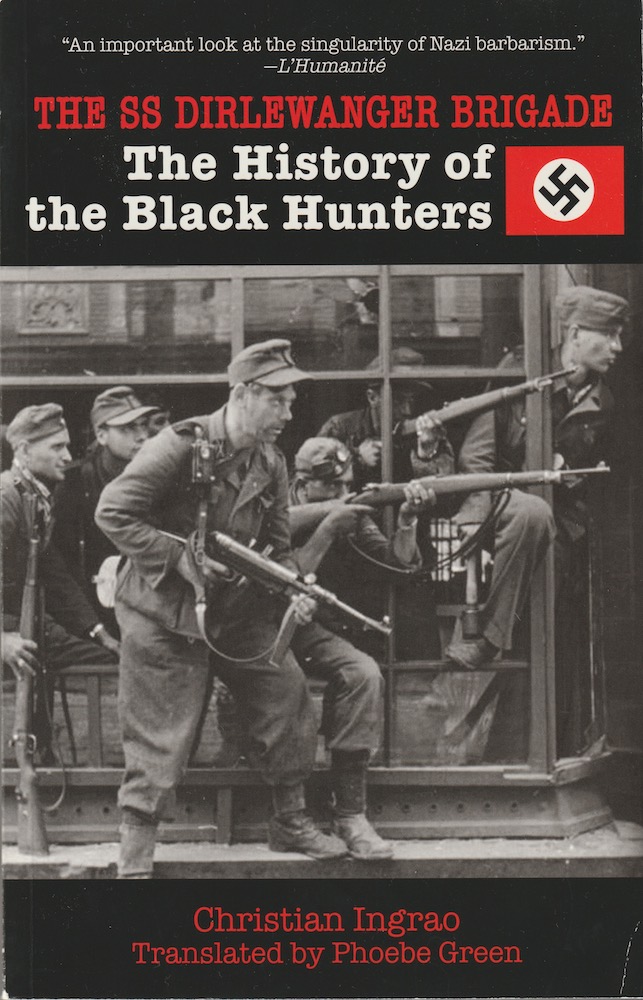
The History Of The Black Hunters
My version: Paperback
Genre: Non-Fiction World War II, Eastern Front, Poland, Soviet Union
Publisher: Skyhorse Publishing
First published: 2011
ISBN: 978-1-62087-631-2
Pages: 208
Bought
From the cover:
The Dirlewanger Brigade was an anti-partisan unit of the Nazi army, reporting directly to Heinrich Himmler. The first members of the brigade were mostly poachers who were released from prison and concentration camps and who were believed to have the skills neccessary for hunting down and captruring partisan fighters in their camps in the forests of the Eastern Front. Their numbers were soon increased by others who were eager for a way out of imprisonment – including men who had been convicted of burglary, assault, murder, and rape.
Under the leadership of Oskar Dirlewanger, a convicted rapist and alcoholic, they could do as they pleased: there were no repercussions for even their worst behaviour. Even by Nazi standards, the brigade was considered unduly violent and an investigation of its activities was opened. The Nazi hierarchy was eager to distance itself from the brigades behaviour and eventually exiled many of the members to Belarus. Based on archives from Germany, Poland and Russia, ‘The SS Dirlewanger Brigade’ offers an unprecedented look at one of the darkest chapters of World War II.
The Dirlewanger Brigade was a German penal unit formed in 1943 from convicted criminals and other undesirables. The brigade was notorious for its brutality and was involved in numerous war crimes, including the massacre of civilians.
The brigade was initially formed as a special unit to carry out anti-partisan operations on the Eastern Front. However, it soon became clear that the brigade was not suitable for this task, as it was more interested in looting and plundering than fighting. As a result, the brigade was reassigned to carry out rear-area security tasks, where it was free to indulge in its criminal activities.
The brigade was involved in numerous war crimes, including the massacre of civilians in Poland, Belarus, and the Soviet Union. The most notorious of these massacres was the Wola massacre, in which the brigade killed over 40,000 civilians in Warsaw in August 1944.
The Dirlewanger Brigade was disbanded in 1945, but its members were not punished for their crimes. Many of them went on to join the ranks of the neo-Nazi movement.
The Dirlewanger Brigade was a dark chapter in German history. It is a reminder of the barbarity that can be unleashed when ordinary people are given power and impunity.
The book is not perhaps as shocking as it certainly could have been, and there would surely have been, during the course of his research, many more horrific facts and incidents than are related here, The Dirlewanger Brigade as presented here, is more of a look at the men who did the deeds, rather than the deeds themselves. So, we are actually looking at an almost philosophical, and therefore somewhat detatched, look at not so much what made these people tick, than why they were drawn to do what they did. He hammers home, one or two times too many for the emphasis to really hit hard (strange as that may seem), the ‘hunter’ and the ‘poacher’ angle of his research. I think he’s understanding (and by understanding, I mean without at any point condoning their actions) why they were driven to commit these attrocities, by their, or the original force and the latter leaders of the group’s poaching and hunting background(s). That maybe they were able to detatch themselves from the horror of hunting and killing other human beings, and see it as a hunter after his prey, I’d guess. Hunting is what they did and because it was quite obviously, even in war, illegal, they were thus ‘poachers.’ As this premis is fairly easily and pretty quickly explained, the book is even at just 200 pages, probably overly long for such a ‘thin’ base idea.
The other interesting (?) part for me is, in all the other books I’ve so far read about the eastern front, the Einsatzgruppen, the Final Solution and the Ordinary Men involved, I’ve yet to come across another, even solitary, mention of this, the Dirlewanger Brigade and/or The Black Hunters. For what seems to have been quite a significant unit in the various horrors perpetrated all over the eastern front, this lack of other references seems a little strange. I obviously need to read some more.
You can buy The Dirlewanger Brigade by Christian Ingrao from Amazon

 Couldn't I Just Tell You