

Ordinary Germans and The Holocaust
My version: Paperback
Genre: Non Fiction, World War II, Eastern Front, Poland
Publisher: Abacus
First published: 1996
ISBN: 978-0-349-10786-8
Pages: 631 (which includes afterword, appendix, notes, acknowledgements, index)
Bought
From the cover:
Published to vast controversy and acclaim, this ground-breaking international bestseller lays to rest one of the most persistent myths about the Holocaust, that most Germans were either ignoorant of the mass destruction of the Jews or participted n it reluctantly. Anyone who reads Hitler’s Willing Executioners, will find compelling evidence that the Final Solution was a national endeavour that engaged the energies and enthusiasm of thousands of ordinary Germans who, nurtured in a society where Jews were seen as unutterably evil and dangerous, willingly followed their beliefs to their logical conclusions.
I’ve often read books about the Second World war and/or the Holocaust and wondered how such deathly hatred of the Jews on the Germans’ side, could just pop up with Hitler – either when he started out in the 1920s, or took power in 1933 – and then disappear again, with Germany’s defeat in 1945. The answer, and I am totally persuaded by all Daniel Goldhagen has set out here is, it didn’t and it didn’t.
Hitler’s Willing Executioners is a controversial yet influential book that offers a provocative interpretation of the Holocaust. Published in 1996, the book argues that the Holocaust was not merely the result of a top-down Nazi regime, but rather the culmination of a deeply ingrained and widely shared antisemitism within German society. Goldhagen contends that ordinary Germans, motivated by a centuries-old tradition of eliminationist antisemitism, willingly participated in the genocide of European Jewry.
The public vitriol against Jews was so ubiquitous in Germany during the Nazi period that it was as impossible for Germans to have had no views about Jews or about the elimination of Jews from German society as it was for Whites in the in the American South during the heyday of the civil rights movement to have had no views about Blacks or about the desirability of desegregation. “Indifference” was a virtual psychological impossibility.“ (page 439)
The book’s central thesis sparked intense debate among historians and scholars. Critics argue that Goldhagen oversimplifies the complex factors that contributed to the Holocaust, neglecting the role of Nazi ideology, political coercion, and bureaucratic mechanisms. They also challenge his assertion of a unique and virulent German antisemitism, arguing that similar prejudices existed in other European countries. Though I don’t recall these other European countries embarking on a programme to murder all of Europe’s Jews.
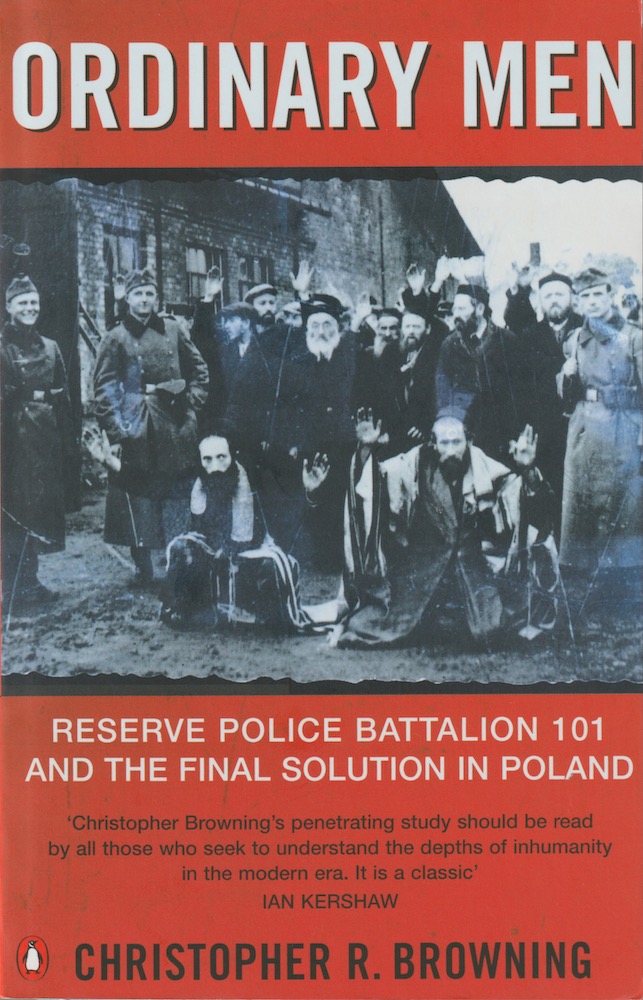
Some of the intense debate, was ‘sparked’ by a book called Ordinary Men, by Christopher Browning. Browning it seems, thought Goldhagen had gone too far in deciding that Germany was thoroughly anti-semitic even a long time before Hitler came to power and harnessed it to further his own ideas. I’m thinking Browning probably took exception to comments like this, on p369; “Their trueness to meting out suffering and death was not an imposed behaviour; it came from within, an expression of their innermost selves.” Browning however, seems to think that much, if not all, of the killings in the east, was able to take place, because ordinary men didn’t want to let the side down, to be ostracised for not taking part. That under other circumstances, they wouldn’t have done this sort of thing. I think with hindsight, he’s relying too much on the men’s post War evidence.
As I said in my review of Ordinary Men, the testimony of the involved men, taken after the war, has got to be taken with a huge pinch of salt, and it seems also to be one of Goldhagen’s conclusions here. He points out, they might well have admitted to some atrocities, but they were coincidentally those crimes for which the statute of limitations had run out by the time they were gving their testimony. The statute for murder in German law, does not run out. Hence their hedging on who actually shot someone or even why.
I have to say I find Goldhagen’s arguments much more convincing and much better argued, than Christopher Browning’s often rather vague ideas. And, having read several World War II books since reading both Ordinarly Men and Hitler’s Willing Executioners, it seems I’m not alone. For example, Richard J. Evans in The Third Reich At War, takes an unmistakable pot-shot directly at Browning:
“These were, therefore, despite claims to the contrary by later historians, neither ‘ordinary men’ nor ‘ordinary Germans.’”
Goldhagen also points out, countering Browning’a arguments, the men took part willingly:(page 237);
“The killers admit that it was the norm for men to volunteer for missions to ferret out, and annihilate more Jews. The killers also tell us that, typically, more men volunteered than was required to fill out a given mission. It is safe to say that these ordinary Germans wanted to kill the Jews.”
And:
“… no German was ever killed or incarcerated for having refused to kill Jews.”
(page 381)
Despite the controversy, Hitler’s Willing Executioners remains a significant contribution to Holocaust studies. It forces readers to confront the disturbing reality that ordinary people can commit horrific acts of violence when exposed to a climate of hatred and dehumanization. The book also raises important questions about the nature of collective responsibility and the potential for genocide in any society.
The book is definitely not for the faint-hearted. There’s a lot – a lot – of evidence presented in a great deal of detail and even then, he often says there’s not enough room in the book to go into as much detail as he thinks the subject actually deserves. But so much detail is necessary I guess, if you are going to present what at the time were some pretty controversian ideas.
While Hitler’s Willing Executioners may not provide a definitive answer to the complex question of how the Holocaust happened, it offers a provocative and thought-provoking perspective that continues to stimulate debate and scholarly inquiry.
You can buy Hitler’s Willing Executioners by Daniel Jonah Goldhagen from Amazon

 Couldn't I Just Tell You