
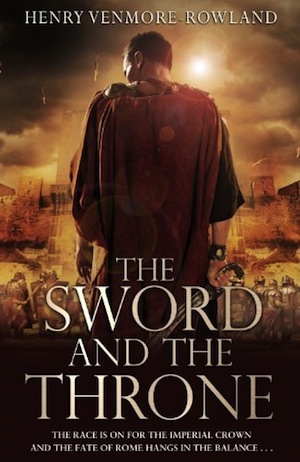
My version: Hardback
Genre: Historical Fiction
Publisher: Bantam Press, Transworld, Random House
First published: 2013
ISBN: 978-0-593-06853-3
Pages: 345
Bought
From the cover:
AD 69, Aulus Caecina Severus has thrown in his lot – and his legions . with the luxury-loving would-be emperor Vitellius.
Driven by both the desire for revenge against his treacherous former patron, the Emperor Galba, and to keep his rival Vaæens in check, Severus leads his army first against the barbarian rebellions and then to the Alps themselves in his race to reach Italy. With the Po valley almost in sight, news reaches him that Galba has been killed in a coup, and that Otho has been declared Emperor by the Praetorians who had been bribed to murder his predecessor.
Now there is no turning back for Severus, even if he wanted to. The Rhine legions want their man on the throne, and they won’t stop until they reach Rome itself. The struggle for supremacy is bitter and bloody. The politics of the court and the mob is the new battleground, and Severus needs the help of those closest to him if he is to with this game of thrones…
Then stories spread of a new power rising in the east and Severus must decide where his loyalty really lies. Is it to his Emperor, to his city – or to himself?
Recounted through the eyes of one of the major players, The Sword And The Throne concludes the brutal story of the brief but pivotal moment in Roman history known as The Year of the Four Emperors.
If you haven’t read Henry Venmore-Rowland’s previous novel The Last Caesar you really should have. However, it’s not vital, you’ll soon get totally caught up in this wonderful book all on its own.
Chances are, if you know anything of ‘The Year of The Four Emperors,’ AD69-ish, then you’ve probably been reading Douglas Jackson and Robert Fabbri (you’ll probably also know, as Douglas Jackson points out, it was actually ‘The 18 Months of the Five Emperors’). I’m going to go out on my rock-solid, totally stable limb here and say The Sword and the Throne puts Henry V-R up there with the two afore-mentioned writers; That is, at the very top of the Roman pile. In my estimation and on my bookshelves anyway. And that’s what counts here.
If you do know anything of the period, you’ll know that the character we’re following, Aulus Caecina Severus, is a young, aristocratic general who was originally loyal to Nero’s successor, Galbus. While Galba promised him some measure of power, that is. Times have changed, Caecina is now feeling overlooked, not to say betrayed, by Galbus and has indeed been ‘recalled’ to Rome, on a “trumped-up charge” of embezzlement. And we all know what that means. Being the serial survivor (serial traitor, if you’re the one currently in The Purple) as he turns out to be, Caecina seizes the next opportunity that comes by, which is to ally himself with Vitellius, who has been thrust, shall we say, forward into declaring himself Emperor. It seems like Caecina is supporting Vitellius partly because he has “all but promised” him promotion to a higher level than Galba had. In the meantime, back in Rome…Galbus has been ‘deposed.’ ‘Deposed,’ ‘murdered,’ what’s the difference? Caecina must now rush with his legions through Switzerland and back to Roman territory, to beat both Otho’s forces and his own rival for Vitellius’ affections, Valens, in the race to have the strongest influence over the new Emperor.
Henry Venmore-Rowland writes in a lively, easy style. Clear and quick-witted. No Latin words dropped in to show off – much more Douglas Jackson than Harry Sidebottom. That’s good, it really is. He also writes in a way that suggests he had a lot of fun writing this. There are also some strong supporting characters in his wife Salonina and his Hibernian Freedman Totavalus, though I would have liked to have heard more of his Gaulish ’Security Advisor’ Lugubrix.
The historical Caecina isn’t supposed – I don’t think – to be a character we need to have much sympathy for (he doesn’t come out of Douglas Jackson’s hands in Sword of Rome, very well, for instance). In The Sword and The Throne, he is painted as having a short temper at times, but makes decisions quickly and decisively and they’re usually turn out to be the right ones. Historically, he seems to have been thought of as an aristocratic back-stabber not particularly interested in the future of Rome, unless it coincided with his plans for his own future, that is. His is a fall from grace that has probably pleased a lot of people down the centuries. However, HV-R has for me, created a strong, character and a story that manages to put over all that, but also paint him (in my view whilst reading anyway) as quite a sympathetic character. I found him likeable and totally understandable in what he did and especially, the why. His fall from grace becomes a tragic one, with an extremely poignant end.
This really is an excellent book, a great story and a very enjoyable read indeed. Talk about bringing history to life! I was left staring into space at the end as my brain tried to cope with how good I thought it was. It just a great shame it isn’t possible to continue the story, if you get what I mean. That’ll have to be left to the very capable pens of Douglas Jackson and Robert Fabbri. Poignant and thought-provoking – the highest praise I can give it, is to say it could have been, should have been and I wish it had been, longer. Though, twice as long would still have been too short. Perfection.
You can buy The Sword And The Throne by Henry Venmore-Rowland from Amazon


