

Karin Müller 2
My version: Paperback
Genre: Fiction
Publisher: Zaffre
First published: 2017
ISBN: 978-1785760686
Pages: 416
Bought
From the cover:
How do you solve a murder when you can’t ask any questions?
The gripping new thriller from the bestselling, award-winning author of Stasi Child.
East Germany, 1975. Karin Müller, sidelined from the murder squad in Berlin, jumps at the chance to be sent south to Halle-Neustadt, where a pair of infant twins have gone missing.
But Müller soon finds her problems have followed her. Halle-Neustadt is a new town – the pride of the communist state – and she and her team are forbidden by the Stasi from publicising the disappearances, lest they tarnish the town’s flawless image.
Meanwhile, in the eerily nameless streets and tower blocks, a child snatcher lurks, and the clock is ticking to rescue the twins alive . . .
David Young’s Stasi Wolf is an atmospheric historical thriller set in 1975 communist East Germany. Following the success of Stasi Child, the novel brings back Oberleutnant Karin Müller, who finds herself sidelined in Berlin and jumps at the chance to investigate a high-stakes case. Sent south to the model socialist city of Halle-Neustadt, Müller is tasked with finding a pair of abducted infant twins. However, she immediately hits a wall of institutional obstruction as the omnipresent Stasi enforce a strict news blackout to protect the pristine political image of their showcase town.

Young’s meticulous research and vivid sense of place lifts the novel up a level or two. Halle-Neustadt – and how he describes its labyrinthine, uniform tower blocks, nameless streets, and underlying industrial bleakness – serves as a chillingly claustrophobic backdrop for a kidnapping investigation. The narrative captures the pervasive paranoia of a surveillance state where neighbour spies on neighbour and even a childhood remark can haunt a person decades later. Against this tense backdrop, Müller emerges as a fiercely independent, resilient protagonist who refuses to be cowed by the regime, even when her own safety and career are on the line.
Beyond the compelling East German police procedural elements, the book succeeds fundamentally as a human story looking at grief, motherhood, and the heavy baggage of the past. Woven into the missing-child investigation are deeply personal subplots, including Müller’s strained relationship with her family and the psychological scars of her own upbringing. Fast-paced, emotionally resonant, and rich in historical detail, Stasi Wolf is an excellent crime novel that marries political tension with a deeply moving character study.
You can buy Stasi Wolf by David Young from Amazon
*Header image is of the building of the Berlin Wall
More on the Stasi, if you’re interested.
The Stasi (officially known as the Ministry for State Security, or Ministerium für Staatssicherheit) was the official state security service and secret police of the German Democratic Republic (East Germany) from 1950 until 1989. Widely regarded as one of the most effective and repressive intelligence and control agencies in history, its primary mission was to protect the ruling Socialist Unity Party and eliminate all forms of political opposition.
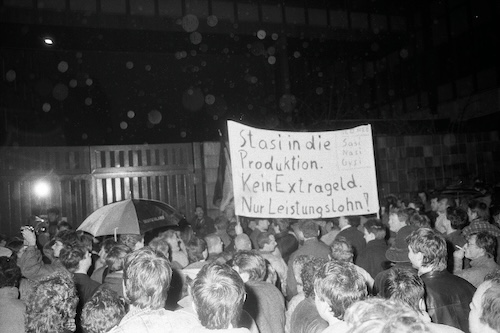
Key aspects of the Stasi include:
- Mass Surveillance: The Stasi maintained an astonishingly vast network of informal informants (Inoffizielle Mitarbeiter), encompassing ordinary citizens, coworkers, friends, and even family members who reported on each other’s daily lives, opinions, and private behaviour.
- Intimidation and “Zersetzung”: Rather than relying solely on traditional imprisonment, the Stasi frequently used psychological warfare – known as Zersetzung (decomposition) – to subtly ruin dissidents’ careers, mental health, and social relationships so they would abandon opposition.
- The Archive: The agency kept exhaustive files on millions of East German citizens. When the regime collapsed in 1989, citizen protesters famously stormed Stasi headquarters in Berlin to prevent the destruction of these records, which are now preserved and accessible for historical research and personal record-checking.
- Headquarters and Reach: Headquartered in East Berlin, the Stasi operated virtually everywhere in public and private life, leaving citizens with a constant, pervasive sense that they were always being watched.


