
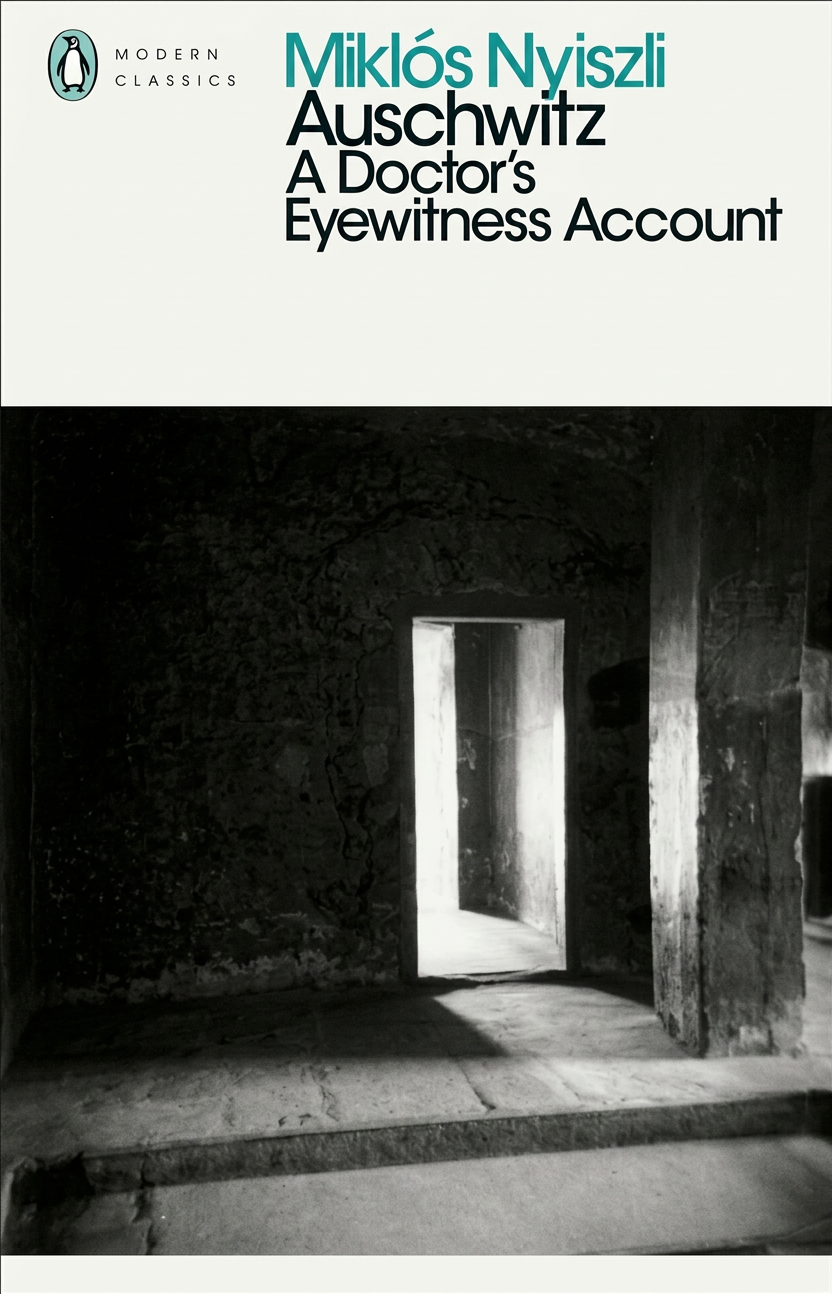
My version: Paperback
Genre: Non Fiction, Auschwitz, The Holocaust
Publisher: Penguin Classics
First published: 1960 (2012)
ISBN: 978-0-141-39221-9
Pages: 161
Bought
From the cover:
In April 1944, Miklos Nyiszli, a Hungarian Jew, was taken to Auschwitz. When he arrived at the camp, he discovered huge crematoria and the ‘nausiating odour of burning flesh and scorched hair,’ but identified himself as an experienced forensic doctor in the belief this could help others. He would soon be working on experiments and autopsies under Joseph Mengele himself, until Auschwitz was finally liberated in 1945.
Auschwitz: A Doctor’s Eyewitness Account is a shocking, controversial and heart-breaking look at one of humanity’s darkest moments, through one man’s honest report of his time there, assisting the very men who were responsible for the deaths of thousands.
I’d be pretty sure that even if you have, like me, read books about or are even partially about Auschwitz, you won’t have been prepared for such a detailled account of the horrors as this is. But not just what happened, what went one and what was done by who, it looks into the minds the hopes the fears, the certainty, the shattering, numbing uncertainty of both himself and many of the prisioners he meets underway.
A Doctor’s Eyewitness Account stands as one of the most chilling and historically invaluable memoirs to emerge from the Holocaust. As a Jewish physician who was forced to assist the notorious Dr. Josef Mengele, Nyiszli provides a rare, firsthand medical perspective from inside the depths of Auschwitz-Birkenau. His unique positioning granted him access to the inner workings of the camp’s administrative machinery, the horrifying selection processes on the ramps, and the industrialized slaughter of the gas chambers. Rather than relying on hearsay, Nyiszli documents the systematic brutality with the detached, clinical observation of a scientist, making the atrocities all the more staggering.
The book’s most harrowing contribution is its detailed exposure of the grotesque human experiments conducted by Mengele. Nyiszli was assigned to the Sonderkommando medical detachment, where he performed autopsies and pathological examinations on twins, dwarfs, and victims of lethal injections to satisfy Nazi racial pseudo-science. Through stark and unvarnished prose, he captures the complete moral inversion of the camp, where the Hippocratic oath was violently perverted into a tool of mass murder. Yet, amidst this profound darkness, the memoir also highlights the quiet, desperate acts of resistance, solidarity, and defiance among the prisoners who sought to preserve their humanity in an environment engineered to destroy it.
Ultimately, Nyiszli’s account is a vital historical document that defies denial and demands active remembrance. By refusing to look away from the mechanized cruelty of the final solution, he ensures that the individual suffering of millions is not lost beneath cold statistics. Auschwitz is not an easy read, but it is an essential one—a haunting testament to the resilience of the human spirit juxtaposed against the absolute zenith of human depravity.
I think the ‘controversial’ aspect (mentioned in the blurb on the back cover) of the memoirs, can be best summarised by what Nikolaus Wachsmann has written in KL. A History Of The Nazi Concentration Camps, on p442:
“The allure of amoral science even captivated some prisoners. Dr Miklos Nyiszli, an accomplished forensic pathologist, was deported with other Jews from Hungary to Auschwitz in May 1944. The SS spared his life because he was healthy and spoke fluent German, and thanks to his medical skills he became a prison doctor at the Birkenau crematoria complex. His superior was none other than Josef Mengele, with Nyiszli serving as his pathology expert; he assisted in murders, dissected twins, wrote up reports, and prepared corpses for skeleton collections. Although he knew all about the depravity of Nazi race science, and was appalled by it, Nyiszli’s passion for science occasionally carried him away. Writing soon after the war, he referred to the “vast possibilities for research in the camp, and recalled with excitement the “curious” and “extremely interesting” medical phenomena he had uncovered during autopsies, and which he had discussed at length, like any medical colleague would, with Dr. Mengele.“
That is of course putting it purely factually, and doesn’t allow for any nuances Nyiszli might have wanted to put on it, but it’s a different way of looking at his actions in the camp. And, Wachsmann later describes Nyiszli as a ‘Kapo,’ which isn’t the nicest thing to have been described as at the time, or later really.
“Some medical Kapos even gave deadly injections and participated in human experiments, as we saw in the case of Dr. Mengele’s assistant Miklos Nyiszli.”
Again, a dry, factual description of his actions, and, as I say, he was in effect forced to do the work he did. And who of us when push came to shove, would have sacrificed our lives on a principle? Not many (I know a few did do, but they’re the exception, rather than the rule). Live and do this, or die right now. I know what I would have said – if he’d not been forced, because of his background, he’d have been murdered along with his fellow countrymen. He was selected for the position he held, because of his medical training. Looking at some discussions of it, it’s like people now blandly, blindly think “he should have done something!” What exactly? Just be thankful we aren’t being put in that sort of moral dilemma. Then, the what could, should, any individual have done in those circumstances leads to whole other type of debate, which I cetrainly am not going to claim I’m qualified to get into.
You can buy Auschwitz A Doctor’s Eyewitness Account by Miklos Nyiszli from Amazon
*This links to the Kindle version, which has the same cover as my Penguin paperback. The paperback covers available on Amazon.c.uk. are absolutely dreadful, not to say misleading. So maybe check it out else where or in a physical bookshop.
**Header image is AI-generated, sorry


