The History of Israel’s Abduction and Execution of the Holocaust’s Architect
My version: Paperback
Genre: Non Fiction
Second World War, The Holocaust
Publisher: CreateSpace Independent Publishing Platform
First published: 2015
ISBN: 978-1508940210
Pages: 46
Bought
From the cover:
“Long live Germany. Long live Argentina. Long live Austria. These are the three countries with which I have been most connected and which I will not forget. I greet my wife, my family and my friends. I am ready. We’ll meet again soon, as is the fate of all men. I die believing in God.” – Adolf Eichmann’s last words.
“He would leap laughing into the grave because the feeling that he had five million people on his conscience would be for him a source of extraordinary satisfaction.” A subordinate on trial at Nuremberg paraphrased a boast of SS-Obersturmbannfuhrer Otto Adolf Eichmann with these words, summarizing the mood and character of Adolf Hitler’s most notorious lieutenant for all posterity.
A serial killer in earth-gray uniform and polished jackboots, Eichmann found an unprecedented opportunity for unleashing his homicidal impulses during the Final Solution from 1942-1945 at the height of the Nazi Third Reich’s rule in Germany. Historians once portrayed Eichmann mostly as a colorless, unimaginative bureaucrat who carried out the Holocaust simply because he lacked the imagination to reject the crime. Essentially “banal,” this version of Eichmann turned him into a compliant functionary who handled the ghastly matter of collecting, transporting, and murdering millions of people with the same bland methodical means that other administrators applied to supplying the Wehrmacht with bread rations or new boots. However, a closer examination of historical documents by other historians such as Bettina Stangneth led to a recent reevaluation of Eichmann. This perhaps more plausible reconstruction of the man reveals a driven hunter rejoicing in his power over his terrified quarry, an individual at once cruel, melodramatic, energetic, and cunning. Eichmann also used his fearsome reputation to carve out a political niche far more influential than his nominal rank – the equivalent of a lieutenant colonel – ordinarily offered. Even when he was captured and in the midst of his enemies, Eichmann showed a keen enjoyment of mental cat-and-mouse games, attempting to outmaneuver his accusers in a manner highly reminiscent of the slippery transformations utilized by manipulative killers such as Ted Bundy. Of course, Eichmann’s story is best known for the way in which the Mossad, Israel’s intelligence agency, kidnapped him out of Argentina in 1960 to put him on trial back in the Jewish State. Employing the same failed defense used by many defendants at the Nuremburg Trials, Eichmann claimed he was simply following the orders of his superiors and was bound by an oath of loyalty, and while judges found him not guilty of personally killing anyone, he was found guilty of crimes against humanity, war crimes, and other crimes before being executed.
The problem is, for decades, the mainstream perception of SS-Obersturmbannführer Adolf Eichmann was defined by the concept of the “banal” bureaucrat—a colourless, unimaginative functionary who orchestrated the logistics of the Holocaust with the same detached methodology one might use to track military rations. Who unthinkingly only followed orders.
But Hanah Arendt was wrong. If she’d stayed at the trial longer, and not been taken in by Eichmann’s ploy of painting himself as a mere functionary, she might well have not permanently set the image we have of him. Modern historical reevaluations paint a far more sinister picture. Eichmann was not a passive gear in the Nazi machine, but rather a driven, cunning hunter who openly rejoiced in his power over his victims. Brandishing a chillingly calculated cruelty, he used his fearsome reputation to wield political influence far beyond his rank, even boasting to a subordinate that he would “leap laughing into the grave” knowing he had millions of consciences on his soul.
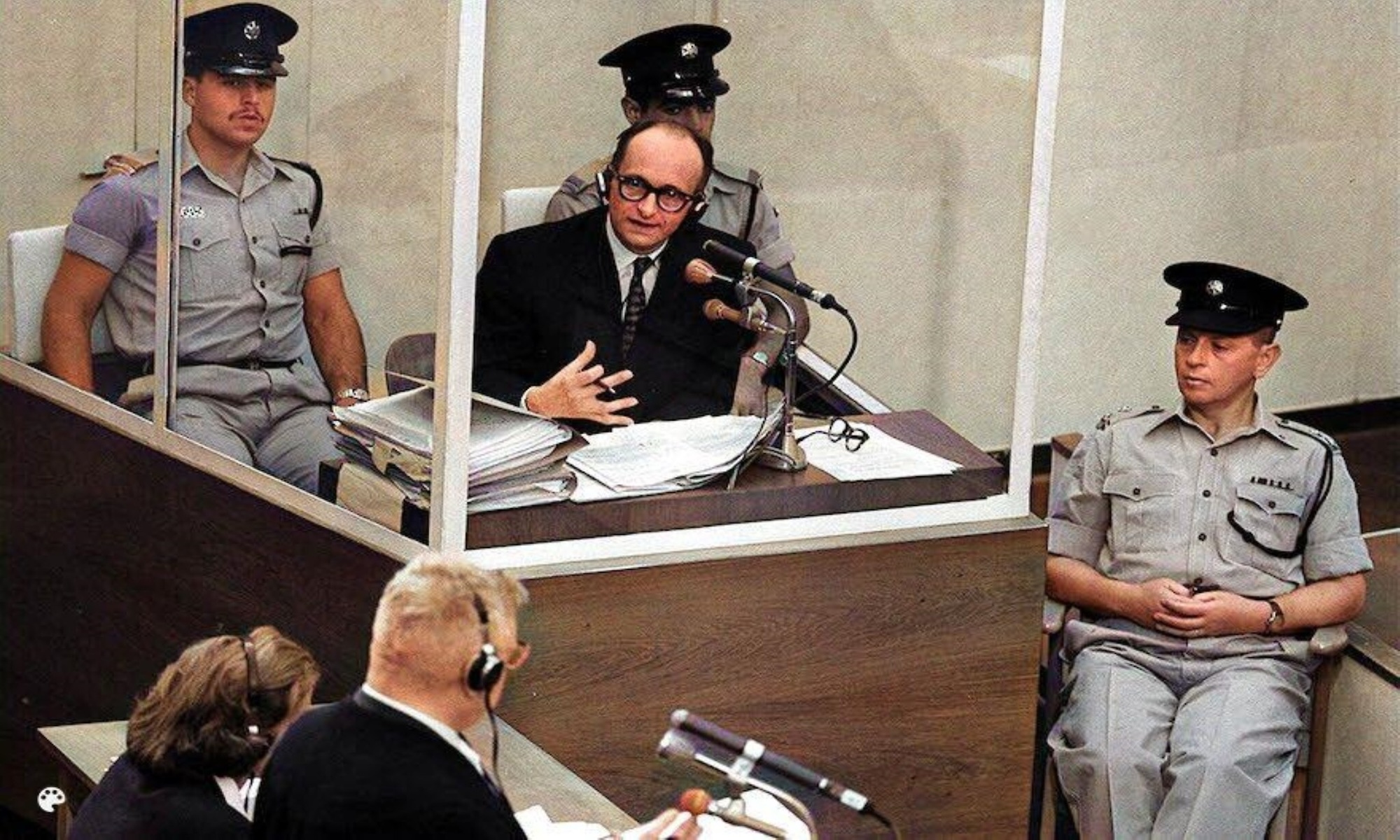
Eichmann’s narrative reached its dramatic climax long after the fall of the Third Reich. In 1960, Israel’s intelligence agency, the Mossad, tracked him to Argentina and kidnapped him to bring the Holocaust architect to justice in the Jewish State. During his subsequent high-profile trial, Eichmann attempted to play a manipulative game of mental cat-and-mouse with his accusers, relying on the failed Nuremberg defense that he was merely a loyal soldier following orders. While the judges noted there was no evidence he personally executed individuals with his own hands, he was rightfully convicted of crimes against humanity, war crimes, and other atrocities, leading to his eventual execution. Up until his final moments, his dramatic defiance remained on full display, ending with his last words: “Long live Germany. Long live Argentina. Long live Austria… I die believing in God.”
For readers looking to go deeper, but quickly into this chapter of modern history, The Capture and Trial of Adolf Eichmann looks at a lot of his wartime actions, his evasion, and his ultimate reckoning. It also features firsthand accounts written by the Mossad participants who found, tracked and captured him. For history enthusiasts and casual readers alike, while there may be other, more comprehensive portraits available, this volume provides a fast-paced yet look into the dramatic fall of someone now recognised ad one of history’s most notorious war criminals.
It’s more of a pamphlet, really. If you order it expecting a ‘proper’ book, book. And wrong on a couple of very obvious and easily checkable points early on. Maybe just for us morbid completists. If that’s a word.
You can buy The Capture and Trial of Adolf Eichmann by Charles River Editors from Amazon