
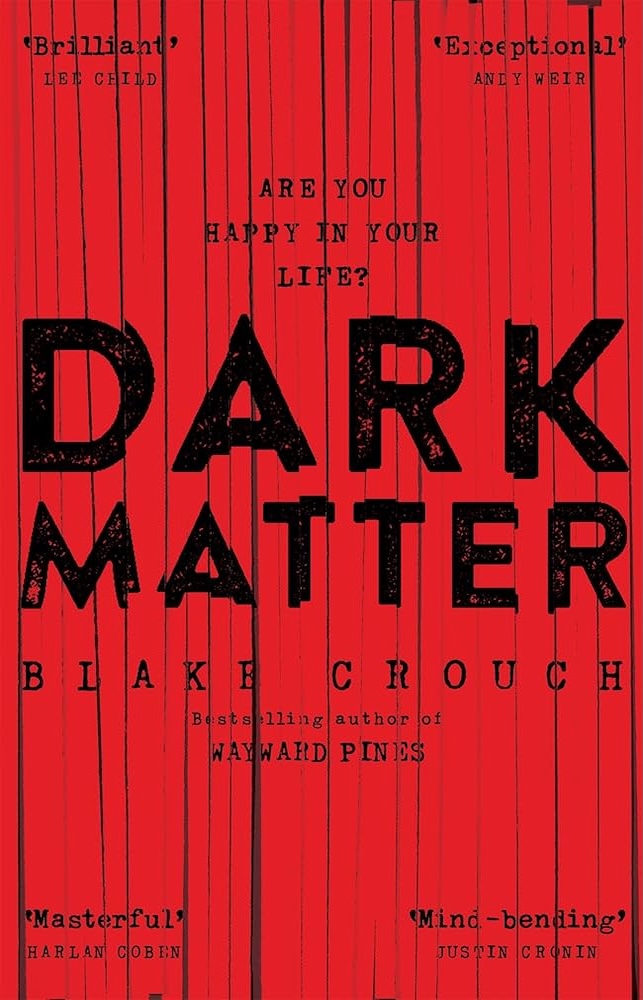
My version: Hardback
Genre: Fiction, Multiverse
Publisher: Penguin Random House, Pan Macmillan
First published: 2016
ISBN: 978-1-4472-9756-7
Pages: 340
Bought, signed
From the cover:
“Are you happy in your life?”
Those are the last words Jason hears before the masked abductor knocks him unconscious.
Before he awakens to find himself strapped to a gurney, surrounded by strangers in hazmat suits.
Before the man he’s never met smiled down at him and says “Welcome back.”
In this world he’s woken up to, Jason’s life is not the one he knows. His wife is not his wife. His son was never born. And Jason is not an ordinary college physics professor, but a celebrated genius who has achieved something remarkable. Something impossible.
Is it this world or the other that’s the dream? And even if the home he remembers is real, how can Jason possibly make it back to the family he loves? The answers lie in a journey more wonderous and horrifying than anything he could’ve imagined – one that will force him to confront the darkest parts of himself even as he battles a terrifying, seemingly unbeatable foe.
An exploration of quantum mechanics, identity, and the profound philosophical question of choice that transcends traditional science fiction boundaries. It’s a high-concept thriller that blends scientific speculation with emotional human drama, creating a narrative that is simultaneously intellectually stimulating and profoundly personal.
The story centers on Jason Dessen, a quantum physics professor and family man living a seemingly ordinary life in Chicago. Jason is content with his modest academic career and loving family—his wife Daniela, an artist, and their teenage son Charlie. One seemingly typical evening, Jason is kidnapped by a mysterious masked man who drugs him and transports him to an alternate reality.
In this new world, Jason discovers a version of himself who has become a brilliant, celebrated quantum physicist—the type of revolutionary scientist he once dreamed of becoming. This alternate Jason has created a groundbreaking technology that allows for quantum superposition on a human scale: the ability to simultaneously exist in multiple realities.
Crouch then procedes to transform a potentially complex scientific concept into a deeply human narrative about identity, choice, and the roads not taken. What defines our identity? How do our choices shape our reality? If infinite versions of ourselves exist in parallel universes, which version is the real us? The protagonist’s journey through multiple realities becomes a metaphorical and literal exploration of life’s infinite possibilities. Each version of Jason represents a different path, a different set of choices, revealing how razor-thin margins can dramatically alter our life trajectories. How they should choose the right one, does in the end seem to be a matter of luck, rather than quantum physics. Physicists and science enthusiasts might quibble with some of the more speculative elements, but Crouch’s commitment to making the science feel credible is commendable. He transforms abstract theoretical concepts into an emotionally resonant narrative. Nothing Michael Crichton hasn’t done before, on a simpler level of course. But that’s just fine with me
Crouch’s writing is propulsive and cinematic. The novel reads like a high-stakes thriller, with short chapters and cliffhanger endings that compel the reader to continue. His background in screenwriting is evident in the visual and dynamic nature of the prose. The scientific concepts are explained with remarkable clarity, making complex quantum theories accessible without sacrificing intellectual rigor. Crouch strikes an exceptional balance between scientific speculation and emotional storytelling.
Jason Dessen is a compelling protagonist—neither a superhero nor a typical action hero, but a relatable academic thrust into extraordinary circumstances. His vulnerability, intelligence, and profound love for his family make him immensely sympathetic.
While Dark Matter (apparently, I have absolutely no idea – I clean toilets in a hospital!) takes significant creative liberties with quantum mechanics, Crouch grounds his speculation in genuine scientific concepts. The novel doesn’t feel like pure fantasy but like an extrapolation of theoretical physics. The novel’s relentless pacing occasionally comes at the expense of deeper philosophical exploration. Still, it’s a novel, not a thesis paper up for peer review afterall. Additionally, the multi-universe concept, while fascinating, could potentially overwhelm readers unfamiliar with quantum theory. However, Crouch’s accessible prose mitigates this potential barrier.
Dark Matter is without doubt a pretty remarkable achievement—a novel that is simultaneously a high-concept sci-fi thriller, a tender love story, and a philosophical exploration of human potential. As evidenced by its apparently successful tv adaptation on Apple TV (is it)?. It’s a book that appeals to multiple audiences: science fiction fans, thriller enthusiasts, and readers who appreciate deep, existential narratives.
By transforming complex scientific theories into a deeply human story of love, choice, and identity, Crouch demonstrates that the most profound scientific explorations are ultimately about understanding ourselves.
And I need to go lie down after all that.


