
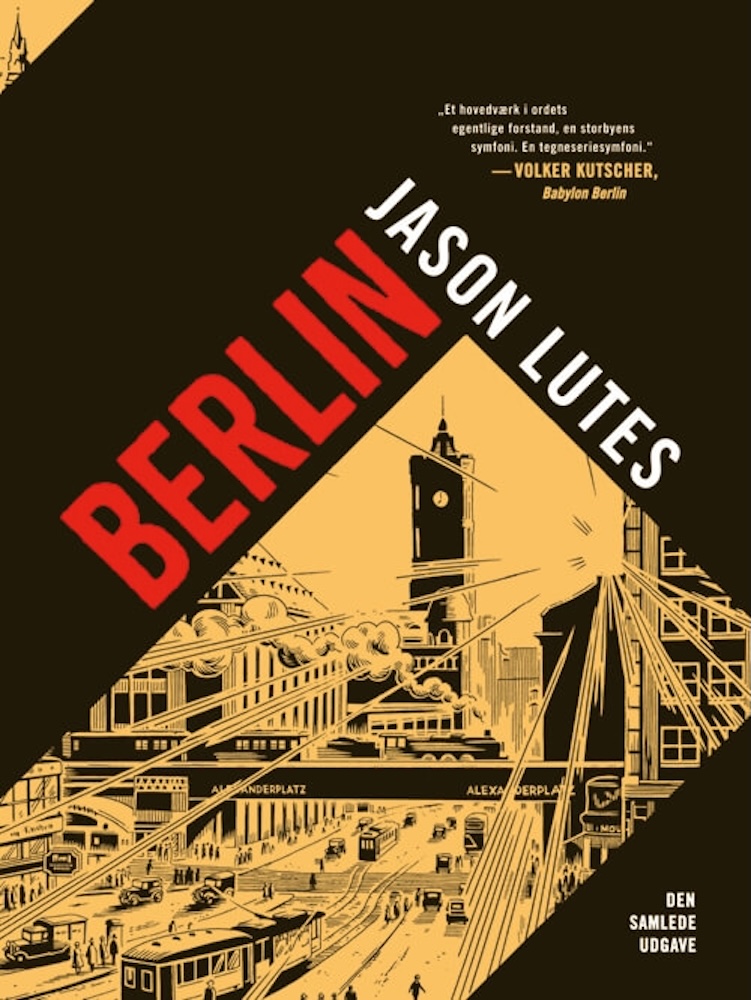
My version: Paperback
Genre: Fiction, Graphic Novel
Publisher: Drawn & Quarterly
First published: 2018
ISBN: 978-1-77046-406-3
Pages: 549
Bought
From the cover:
“Berlin is one of the great epics of the comics medium.
Jason Lutes creates an intricate look at the German metropolis during the Jazz Age., seen through the eyes of its residents. Their lives intersect at the crossroads of kindness and cruelty, love and hate, sex and death. The city of Berlin itself comes alive, with its smoke-filled salons, crumbling sidewalks, bustling train stations, and raucus nightclubs. During the Weimar Republic, Berlin was the progressive centre of Europe, where creativity, political thought, and sexual liberty burned bright before being snuffed out under the boot heel of fascism.
Devastatingly relevant and beautifully executed.”
First of all, The Weimar Republic:
The Weimar Republic was Germany’s government from between the end of the Imperial period (1918) and the beginning of Nazi Germany (1933). It was named after the town of Weimar where Germany’s new government was formed by a national assembly after Kaiser Wilhelm II abdicated.
Something of a departure for me, a Graphic Novel. And it’s a big one, weighing a ton. Not so easy to sit and read at all. Best done at a table, over several days, I’d say. As I did.
No doubt exhaustively researched. It took 22 years to put together, according to The Guardian‘s review quoted on the back.
The main character, the ‘lead’ character who holds the whole, sprawling story together, is Marthe Müller. She travels to Berlin from her home town of Köln (Cologne) in 1928. She’s a fairly innocent young girl who wants to develop her drawing skills, to see if Art School in Berlin is something for her. She meets people, falls in love, twice, and falls in love with the city and all it has to offer in this famous age of decadence.
The novel does a really good job of putting over the almost desperate feeling of what were obviously turbulent times. Germany had lost the First World War, but felt they hadn’t. The feeling of being ‘stabbed in the back,’ of people back in Germany not supporting the brave soldiers at the front to the full, that Hitler utilised later. There’s a real feeling of a chaotic, living on the edge, desperate, anything goes, something’s got to change, it can’t go on like this but let’s party while it does, attitude. People trying to come to terms with the ‘so what do we do now?’ The Political vacuum left by the Kaiser’s abdication sucks in forceful characters from the whole spectrum of political ideas. But it is the clash between the Soviet Union leaning Communists and the rapidlt developing Fascist National Socialists that brings the chaos to a head. With all the characters the story follows being swept up in it, often, and especially in the case of the Jewish people, against their will.
Though it is let down a little by some slap-dash drawing here and there. Which given the mixed, multiple story threads being interwoven, makes it sometimes difficult to figure out which character it is we’re with at the time.
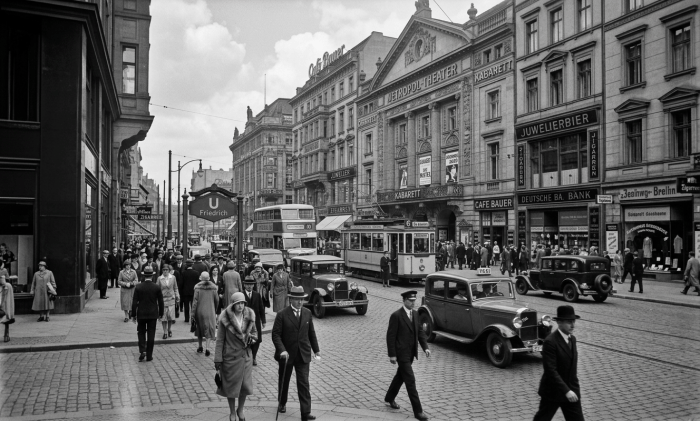
As an endnote, I thought you might like to see WordPress AI”s version of ‘Berlin in the 1920s,’ which seems to include what looks very much like a London Bus, and some very strange lettering on the Taxi sign. The header image I used, seems to be from a postcard from the time. Can’t quite make out if any of the people in the foreground have six fingers, mind.


