
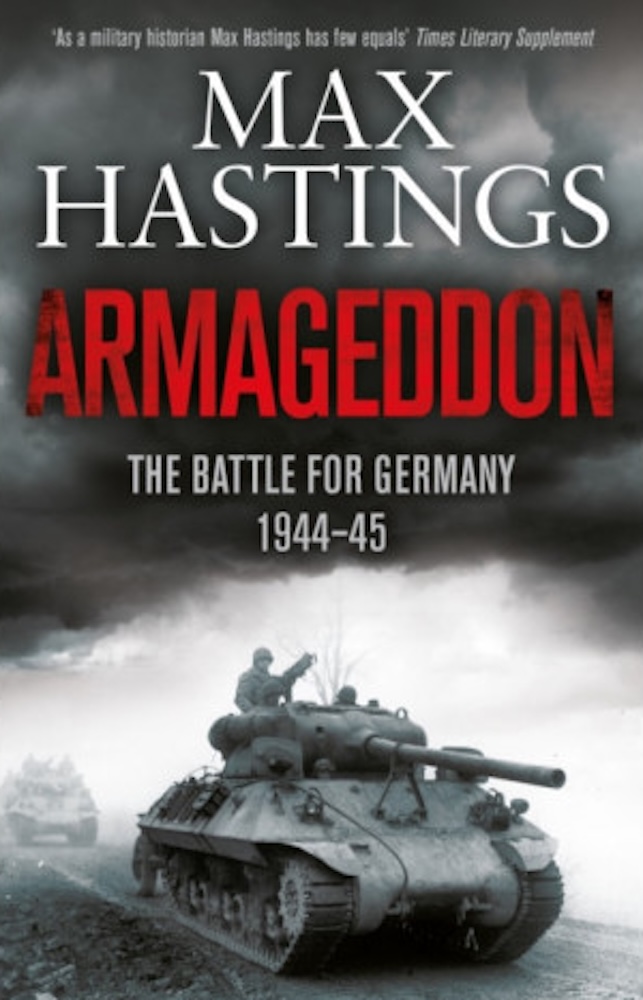
The Battle For Germany 1944-45
My version: Hardback
Genre: Non Fiction, World War 2
Publisher: Macmillan
First published: 2004
ISBN: 978-1-6098-3994-0
Pages: 591
Bought
From the cover:
In Armageddon, one of Britain’s most highly regarded historians tells the epic story of the bloody last eight months of the war in Europe.
In 1944, German forces suffered defeats during the battles for Holland and the German border. Yet in the following weeks the ailing Wehrmacht was able to achieveone of the greatest military feats of the Second World War. The Germans regrouped, transformed their activities and somehow found the strengthto halt the seemingly inexorable Allied advance in its tracks. prolonguing the war into 1945.
Drawing on fascinating individual experiences, Max Hastings’ masterly account provides a fresh and gripping insight into the final twists and turns of the war, revealing how Europe’s fate hung in the balance until the bitter end.
Armageddon: The Battle for Germany, 1944–1945 is a comprehensive, narrative-driven overview of the final eleven months of World War II in Europe. As always, Hastings meticulously pieces together the multi-front collapse of the Third Reich, intentionally shifting focus away from high-level political maneuvering to emphasize the gritty reality of the front lines. By weaving together the experiences of British, American, Soviet, and German soldiers, airmen, sailors, civilians – ranging from supreme commanders to refugees – the book captures the sheer scale of human suffering that defined the war’s conclusion. Rather than treating the final months as a simple, triumphant victory lap for the Allies, Hastings presents it as it was – a grueling, bloody slog characterized by strategic miscalculations, missed opportunities, and immense devastation.
A defining strength of Hastings’ historical analysis is his objective and unsparing evaluation of national militaries and their leadership. He challenges the romanticized mythology often surrounding the Western Allies, noting that British and American commanders frequently displayed a cautious, over-engineered approach to maneuver warfare that prolonged the conflict. Conversely, Hastings acknowledges the tactical and operational superiority of the German Wehrmacht, though he frames this efficiency alongside the fanatical, self-destructive obstinacy of the Nazi regime that forced its own population into an absolute catastrophe. Furthermore, he treats the Eastern Front with the gravity it demands, illustrating how the Red Army bore the primary burden of defeating Germany, while frankly documenting the widespread atrocities and systemic violence committed by Soviet troops as they advanced into the Reich.
Ultimately, Armageddon functions less as an institutional military chronicle and more as an exploration of human endurance and moral ambiguity under the pressure of total war. Which is true for all the history of WWII books I have read by Max Hastings. He succeeds in balancing macro-level campaign movements – such as the failure of Operation Market Garden, the Battle of the Bulge, and the final assault on Berlin – with micro-level human drama extracted from letters, diaries, and interviews. The narrative refuses to shy away from uncomfortable truths, illustrating that the path to liberation was paved with immense collateral destruction, including the devastating Allied strategic bombing campaigns. The result is a highly readable, sober, and balanced work of popular history that vividly reminds the one of the immense human cost required to dismantle the Nazi regime, even in the final months.
You can buy Armageddon by Max Hastings from Amazon
*Yeah, it’s an AI generated image at the top


